


The Problem & The Solution
The Challenge: Starlink’s growing workforce, spanning corporate employees, outsourced teams, and field staff, had no single, reliable way to interact with HR services. Employees juggled multiple channels: phone calls for service requests, emails for document access, manual follow-ups for request status, and bulletin boards for company news. The result was a fragmented, frustrating experience that cost employees time, created information gaps, and put unnecessary pressure on HR teams to handle avoidable follow-up traffic.
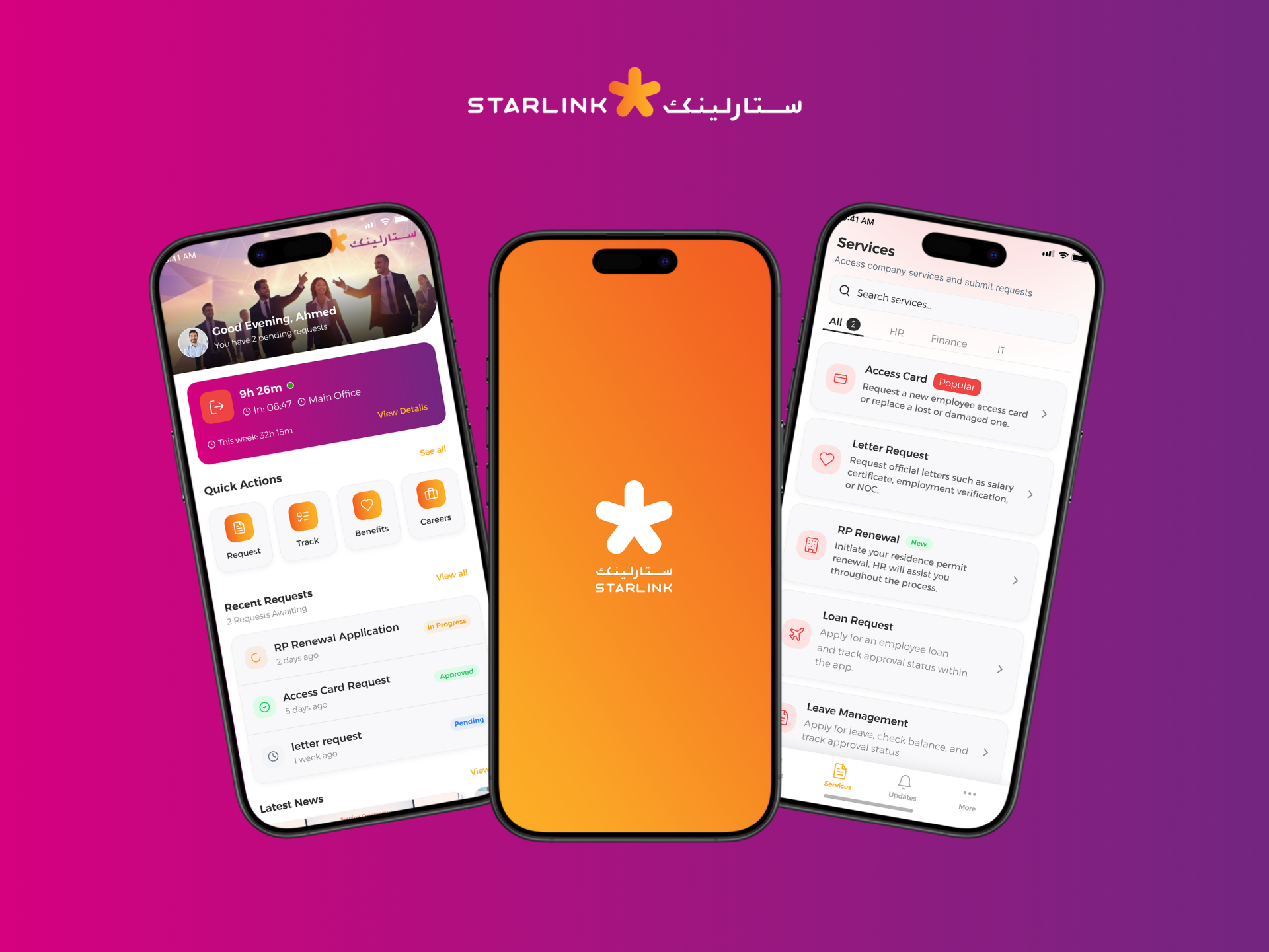
The Transformation: We designed a purpose-built employee self-service mobile application that consolidates every HR touchpoint into one cohesive, intuitive platform — from secure login and document access to real-time request tracking and internal career exploration. The outcome: empowered employees, reduced HR overhead, and an organization that communicates with clarity.
Project Overview
Starlink operates a large and distributed workforce, including both corporate employees and outsourced staff. Managing HR services at this scale requires precision, transparency, and accessibility, qualities that legacy communication methods simply cannot provide.
The brief was direct: design a mobile-first employee platform that eliminates HR friction, gives employees ownership over their own service journey, and provides management with real-time operational visibility, all wrapped in a clean, secure, and role-aware interface.
The application was designed to serve three distinct user roles:
-
Employees: accessing benefits, submitting requests, viewing documents, and exploring career opportunities
-
Managers: reviewing team activity, monitoring request workflows, and accessing key HR data
-
Administrators: managing user access, maintaining records, and overseeing system-wide activity
The platform covers eight core modules: User Management & Authentication, Document Center, Employee Benefits, Employee Services, Request Tracking, Career Opportunities, Company Announcements, and Company News.
Problem Statement
Before this application existed, Starlink employees faced a consistent set of pain points that compounded into a broader organizational inefficiency:
1. No Single Source of Truth
Employees couldn’t find company policies, HR forms, or employee handbooks without reaching out to HR directly. Documents were stored across shared drives, email threads, and intranet pages that were rarely up-to-date.
2. Service Requests Were a Black Box
When employees submitted requests for access cards, residence permit renewals, or other services, they had no way to track progress. Every status update required a manual follow-up call or email, adding friction for both the employee and the HR team processing the request.
3. Communication Was Reactive, Not Proactive
Company announcements, policy updates, and industry news were distributed through email blasts that got buried in inboxes. There was no centralized, real-time channel for organizational communication.
4. Career Growth Was Hidden
Internal job openings weren’t easily discoverable. Employees who wanted to grow within Starlink had no dedicated, low-friction way to explore and apply for internal roles, a missed opportunity for talent retention and internal mobility.
5. Benefits Were Underutilized
Employees weren’t aware of the full range of benefits available to them. Without a consolidated view of wellness programs, insurance plans, and discount perks, many employees left value on the table.
The core problem wasn’t any single failure it was the absence of a unified system that respected the employee’s time and gave them agency over their own HR journey.
Goals & Objectives
Primary Design Goal:
Create a mobile application that serves as the single, trusted destination for every employee’s HR needs, reducing dependence on manual processes and enabling self-service at scale.
Specific Objectives:
-
Reduce the volume of routine HR inquiries by enabling employees to self-serve information and requests
-
Provide real-time visibility into request status to eliminate follow-up communication
-
Centralize access to all company documents, ensuring they are always current and secure
-
Surface benefits information clearly so employees can discover and utilize what’s available to them
-
Facilitate internal career mobility through an accessible, in-app job board
-
Deliver timely company communications through push notifications and in-app announcements
-
Support role-based access to ensure data security across employees, managers, and administrators
Target Users
Understanding who would use this application, and how, shaped every design decision we made.
The Corporate Employee
Works within Starlink’s offices, relies on the app daily for information access, submitting service requests, and staying informed. Values speed and clarity. Doesn’t want to search for things, expects them to surface intuitively.
The Outsourced / Field Staff Member
May have limited familiarity with internal systems. Needs a clear, guided experience, especially for processes like RP renewal or access card requests that have legal and logistical stakes. Values straightforward steps and confirmation at every stage.
The Manager
Needs visibility into team activity and request workflows. Expects role-appropriate data without being overwhelmed with administrative clutter. Values efficiency and overview-level clarity.
The HR Administrator
Power user of the system. Requires secure, reliable access to employee records and operational data. Needs to trust that the system is accurate, role-restricted, and audit-ready.
Research & Insights
Understanding the Landscape
Before touching any interface, we invested time in understanding how employees currently navigated HR workflows, and where those workflows broke down.
Stakeholder Discovery Sessions
We conducted structured interviews with HR managers and department leads to map the current state of employee service delivery. Key findings:
-
HR teams estimated that 40–50% of their inbound queries were requests for information that should be self-service
-
Residence permit renewal and access card requests consistently had the highest follow-up rates due to lack of status visibility
-
Managers had no consolidated view of team requests; they relied on verbal updates from HR
Employee Feedback Analysis
We reviewed existing employee satisfaction data and communication logs to identify the most frequently cited friction points:
-
“I didn’t know that benefit existed until someone told me,” is a recurring theme around benefits awareness
-
Employees expressed frustration at not knowing if their requests had been received, let alone processed
-
Company announcements often reached employees days after they were issued, through informal channels
Competitive & Analogous Research
We analyzed employee self-service platforms across enterprise, government, and large-scale corporate environments. Key observations:
-
The most effective platforms prioritized task completion over feature completeness: users wanted to do specific things quickly, not explore a product
-
Status visibility is a non-negotiable in any request management flow. Uncertainty breeds follow-up.
-
Mobile-first is no longer a differentiator — it’s an expectation. Employees expect the same quality of digital experience at work that they have as consumers
Key Design Principle Derived from Research:
The best employee platform is invisible, it gets out of the way and gets things done.
Design Process
Phase 1: Discovery & Definition
We mapped the full employee journey across all HR touchpoints, identifying moments of friction, anxiety, and dropped tasks. This became the foundation for our information architecture.
Phase 2: Information Architecture & User Flows
We structured the app around eight core modules, each with a distinct purpose and a clearly defined entry point. Navigation was designed to be flat no more than two taps from the home screen to any critical action. We created detailed user flows for each module, with particular attention to the service request and tracking journeys, which carried the highest stakes for users.
Phase 3: Research & Wireframes
Low-fidelity wireframes were created for all key screens, focusing on layout logic, hierarchy, and interaction patterns before any visual decisions were made. This phase included wireframes for:
-
Authentication (login, role selection)
-
Home Dashboard
-
Document Center
-
Employee Benefits (listing + detail)
-
Services (request initiation flows)
-
My Requests (status tracking)
-
Career Opportunities (listing + job detail + application)
-
Announcements & News Feed
Wireframes were reviewed with HR stakeholders to validate task flows and ensure alignment with backend processes.
Phase 4: Visual Design
With validated flows in hand, we moved into high-fidelity UI design. The visual language was defined by three principles:
-
Clarity: High contrast, clean typography, and ample spacing to ensure readability across device sizes and lighting conditions
-
Brand Alignment: A professional palette anchored in Starlink’s corporate identity, conveying authority and trustworthiness
-
Accessibility: Touch targets, color contrast ratios, and text sizing are all designed to meet accessibility standards for a diverse workforce
Phase 5: Prototyping & Iteration
Interactive prototypes were built in Figma and shared with a small group of employees across roles for usability feedback. Findings were incorporated before finalizing the design handoff.
Challenges & Solutions
Challenge 1: Designing for a Diverse, Multi-Role User Base
A single application serving employees, managers, and administrators with vastly different needs and technical comfort levels could easily become a compromise that serves no one well.
Solution: We defined clear design personas for each user type and mapped their distinct journeys before designing a single screen. Role-based personalization was built into the system architecture from the start, ensuring that the interface adapts to the user rather than forcing the user to adapt to the interface.
Challenge 2: Making Request Tracking Trustworthy
Employees had been burned by systems that claimed to track requests but provided no real-time updates. There was a trust deficit to overcome.
Solution: We designed the tracking system with radical transparency — every status change is logged and visible, including the timestamp and the name of the approving party. Proactive push notifications at each stage reinforce that the system is actively working, not just storing data. Trust is built through consistent, accurate feedback loops.
Challenge 3: Surfacing Benefits Without Overwhelming Users
Employee benefits span multiple categories, insurance, wellness, discounts, and perks. Presenting them all at once risked information overload; presenting too few risked the same underutilization that research identified.
Solution: We implemented a category-filtered benefits discovery layout. Employees can browse by category or view all benefits in a scannable card grid. The detail view for each benefit provides full information and a direct action to apply, enrol, or learn more, in one place.
Challenge 4: Keeping Communication Timely and Relevant
Company-wide announcements and general news have different urgency levels. Treating them the same would either desensitize employees to alerts or leave them uninformed about critical updates.
Solution: We separated Announcements (high-priority, management-issued, push-notified) from Company News (broader, informational, browsed at the user’s pace). This distinction preserves the signal value of urgent communications while still providing a rich information environment for engaged employees.
Final Outcome / Impact
The Starlink Employee Hub delivers a fundamentally better relationship between the organization and its workforce, one built on transparency, self-service, and timely communication.
For Employees:
-
One app for every HR need, no more cross-channel hunting for information
-
Real-time visibility into every service request, eliminating uncertainty
-
Discovery of benefits they didn’t previously know existed
-
A direct, low-friction path to internal career growth
For HR Teams:
-
Significant reduction in routine inbound inquiries as employees self-serve information and track